
Posted on Leave a comment

A Simple 2-Stroke Fuel Mix Calculator for Everyday Equipment

Mixing fuel for a 2-stroke engine is not particularly complicated.

At least, it should not be.

You have a quantity of fuel, a required fuel-to-oil ratio, and an amount of 2-stroke oil that needs to be added. The calculation itself is straightforward, but it becomes surprisingly easy to second-guess when you are standing beside a mower, chainsaw, brushcutter, blower or another piece of equipment with a fuel container in front of you.

Was that 25:1 or 40:1?

How much oil is needed for this amount of fuel?

Was the measurement calculated using litres, US gallons or UK gallons?

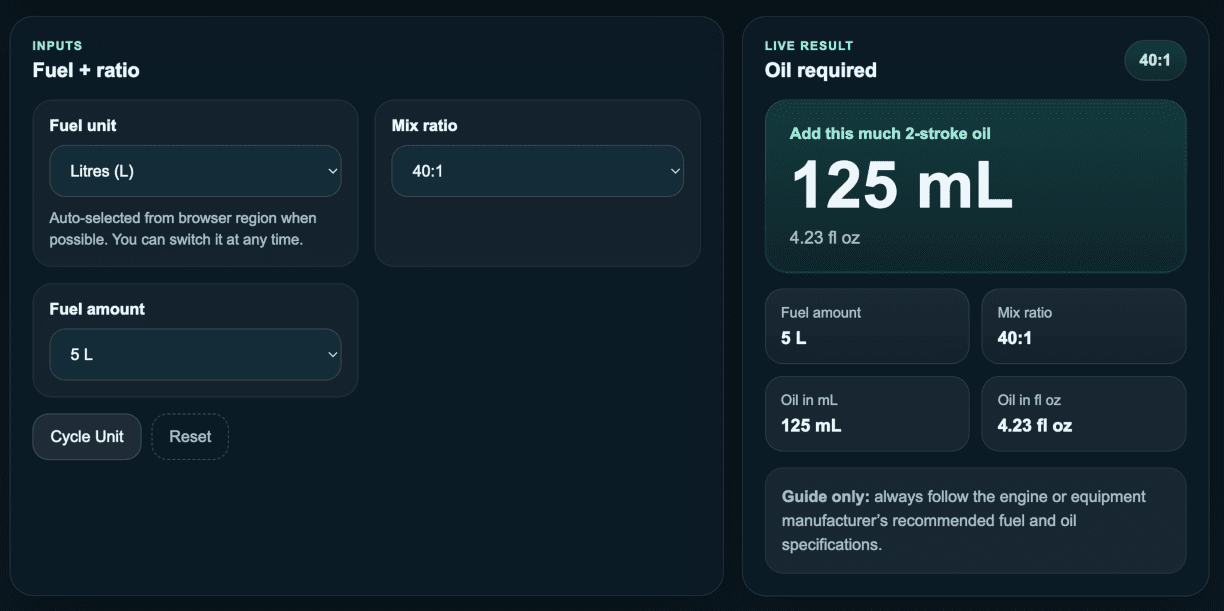
Rather than repeatedly looking up conversion tables or reaching for a calculator, I created the Jays n Dees 2-Stroke Fuel Mix Calculator.

What the Calculator Does

The calculator works out how much 2-stroke oil is required for a selected amount of fuel and fuel-to-oil ratio.

You choose:

  • the unit used to measure the fuel
  • the required mixing ratio
  • the amount of fuel being prepared

The calculator then displays the corresponding oil quantity.

It supports:

  • litres
  • US gallons
  • UK gallons
  • common fuel-to-oil ratios
  • custom ratios
  • preset fuel quantities
  • custom fuel quantities

This means it can be used with a range of equipment and measuring systems without manually converting everything first.

Why the Different Gallon Types Matter

One reason fuel calculations can become confusing is that a gallon is not always the same quantity.

A US gallon and a UK imperial gallon are different sizes. Using the wrong gallon measurement can therefore produce the wrong oil quantity, even when the mixing ratio itself is correct.

The calculator treats litres, US gallons and UK gallons as separate units.

Where possible, it uses the browser region to select a likely starting unit, but that selection can be changed at any time. There is also a Cycle Unit button for quickly moving between the available measurement systems.

Common and Custom Mixing Ratios

Many pieces of 2-stroke equipment use familiar ratios such as 25:1, 40:1 or 50:1.

The calculator provides common ratio choices for convenience, but it is not limited to those options. A custom ratio can be entered when a particular engine or manufacturer specifies something different.

For example, entering 25 represents a fuel-to-oil ratio of 25:1.

This flexibility is useful because not every 2-stroke engine uses the same mixture. Older equipment, newer equipment and specialised engines may all have different requirements.

The calculator does not attempt to decide which ratio your equipment needs. That information must come from the equipment manufacturer, instruction manual or another reliable specification for the engine.

Its job is to calculate the oil quantity after you provide the correct ratio.

Saving Frequently Used Mixtures

Most people who regularly use 2-stroke equipment tend to prepare the same few mixtures repeatedly.

You may always mix:

  • the same fuel quantity
  • in the same unit
  • at the same ratio

The calculator allows useful combinations to be saved as favourites for quicker reuse.

These favourites are stored locally on the device rather than being attached to an online account. This keeps the feature simple and avoids requiring registration merely to save a common calculation.

Once saved, a favourite can be selected again without rebuilding the mixture from the beginning.

Available Online and Offline

The calculator is built as an installable Progressive Web App, commonly shortened to PWA.

That means it can be opened through a web browser and, on supported devices and browsers, installed for more app-like access. It is also designed to remain available offline after it has been loaded and installed correctly.

Offline access is particularly useful for this kind of tool.

Two-stroke equipment is often used in sheds, gardens, paddocks, workshops and other places where an internet connection may be weak or unavailable. A calculator that stops working when the connection disappears would be far less useful.

The saved favourites also remain on the device for convenient reuse.

A Small Tool for a Specific Job

The 2-Stroke Fuel Mix Calculator is deliberately focused.

It is not an equipment-management platform, maintenance tracker or complicated workshop system. It does not require an account, and it does not try to recommend a mixing ratio without knowing the engine involved.

It performs one practical job:

It calculates the amount of 2-stroke oil required for the fuel quantity and ratio you select.

Sometimes that is all a tool needs to do.

Always Check the Manufacturer’s Requirements

The calculator is provided as a mixing guide.

Always confirm the correct fuel type, oil type and fuel-to-oil ratio specified by the engine or equipment manufacturer before preparing a mixture.

Using the wrong ratio or unsuitable oil may affect performance or damage equipment. If the instructions printed on the equipment differ from information found elsewhere, follow the applicable manufacturer documentation.

Once the correct ratio is known, the calculator can take care of the maths behind it.

Try the Free Calculator

The Jays n Dees 2-Stroke Fuel Mix Calculator is available free through the Jays n Dees website.

Open the 2-Stroke Fuel Mix Calculator

Choose the fuel unit, select or enter the required ratio, enter the amount of fuel, and the calculator will show how much oil to add.

Save the combinations you use regularly, and the next mixture should take only a few moments to calculate.

Posted on Leave a comment

Moon Planting in the Southern Hemisphere: A Practical Overview

Moon planting is a traditional approach to gardening that uses the phases of the moon as a planning reference for different types of garden work. It’s often discussed in broad terms, but when you start looking for practical guidance – especially in the Southern Hemisphere – the information can quickly become confusing.

This post provides a clear, practical overview of moon planting as it applies to the Southern Hemisphere, with an emphasis on using it as a planning aid rather than a strict rulebook.

What Is Moon Planting?

Moon planting is based on the observation that the moon’s cycles appear to coincide with natural rhythms in growth, moisture, and biological activity. Traditionally, different moon phases have been associated with different types of gardening tasks.

It’s important to frame this correctly:

  • moon planting is a traditional and observational practice
  • it is not a guarantee of outcomes
  • it works best when combined with local knowledge and experience

Many gardeners use moon planting not to dictate what must be done, but to help decide when to do things they already intend to do.

Why Moon Planting in the Southern Hemisphere Needs a Different Approach

One of the biggest sources of confusion around moon planting is that much of the available guidance assumes Northern Hemisphere seasons.

In the Southern Hemisphere:

  • seasons are inverted
  • month-to-season relationships differ
  • climate variation is significant even within the same country

This means that simply following a Northern Hemisphere moon planting chart can lead to mismatches between lunar advice and actual growing conditions.

For Southern Hemisphere gardeners, moon planting guidance only becomes useful when it is interpreted in context, rather than followed verbatim.

Moon Phases and General Gardening Activities in Moon Planting

Rather than rigid rules, most moon planting traditions associate moon phases with types of activity. These associations are best treated as planning cues, not instructions.

New Moon

Often associated with:

  • planning and preparation
  • soil improvement
  • light sowing of leafy crops

This phase is commonly treated as a starting point in the lunar cycle.

Waxing Moon

Typically linked to:

  • above-ground growth
  • planting or transplanting
  • encouraging leafy development

Gardeners who follow moon planting often use this phase for activities that benefit from upward growth.

Full Moon

Often associated with:

  • observation and harvesting
  • seed collection
  • general garden maintenance

Rather than intensive planting, this phase is frequently treated as a checkpoint in the cycle.

Waning Moon

Commonly linked to:

  • root crops
  • pruning
  • weeding
  • composting and soil work

The waning phase is often used for tasks that focus below ground or involve reducing growth.

Using Moon Planting as a Planning Aid in the Southern Hemisphere

The most practical way to approach moon planting is to treat it as one input among many, rather than a deciding factor on its own.

Effective gardening decisions still depend on:

  • local weather conditions
  • soil quality
  • plant varieties
  • seasonal timing
  • available time and energy

Moon planting can help structure when you do certain tasks, but it shouldn’t override real-world constraints.

Many experienced gardeners find moon planting most useful when it:

  • reduces indecision
  • creates a rhythm for planning
  • encourages observation over time

    This overview focuses on how moon planting is commonly interpreted in Southern Hemisphere contexts, rather than promoting it as a set of fixed rules.

A Note on Calendars, Charts, and Tools

Static moon planting charts can be helpful as a reference, but they also have limitations.

Common issues include:

  • lack of localisation
  • assumptions about climate
  • fixed rules that don’t adapt well

For gardeners who want consistency without rigidity, systems that separate data (moon phases, seasons) from decisions tend to work better than fixed guides.

This approach allows moon planting to support planning without becoming prescriptive.

Building a Reusable Approach

While this post focuses on understanding moon planting in general terms, it’s often helpful to translate that understanding into a repeatable structure.

To reduce repeated interpretation, I eventually documented how I built a simple moon planting system specifically for the Southern Hemisphere, focused on planning rather than prediction. That project is covered in detail here:

Building a Moon Planting System for the Southern Hemisphere

This case study explains how the information above was organised into a reusable framework, and why flexibility was prioritised over rigid rules.

Final Thoughts

Moon planting in the Southern Hemisphere, and especially Australia, works best when approached thoughtfully.

Rather than asking whether it “works” in absolute terms, a more useful question is:

Does this help me plan my gardening activities more clearly and consistently?

Used as a planning aid – alongside observation, experience, and local conditions – moon planting can provide structure without adding complexity.

As with most long-term gardening practices, its value tends to come not from strict adherence, but from paying attention over time.


RELATED ARTICLES: