Posted on Leave a comment

Not a Get-Rich-Quick Scheme: A Micro-Earnings Site That Has Actually Paid Me Since 2023

I am usually fairly cautious when it comes to “make money online” websites.

That is not because every online earning site is bad, but because the space is absolutely full of exaggerated promises, unrealistic earnings claims, and platforms that sound far better than they actually are.

So when I do talk about one, I prefer to be very clear about what it is, what it is not, and why I personally still use it.

The site I want to talk about in this post is Serpclix, a micro-earnings style website that I first started using in early 2023.

Since then, it has continued to provide monthly payments to my PayPal account, in USD.

That does not mean it is a magic money machine. It does not mean it will replace a job. It does not mean you will suddenly be earning huge amounts online.

But it does mean something important:

For me personally, it has been consistent.

And in the world of micro-earning websites, consistency matters just as much on the ease of tasks involved.


What Is Serpclix?

Serpclix is a micro-earnings PTC website.

In simple terms, that means it gives users the opportunity to earn small amounts of money through the activities available on the platform.

The entire focus of the platform is Search Engine Results. More specifically, it is about the keywords that drive customers to specific websites.

You will earn by completing simple search oriented tasks, or orders, that become fulfilled once your click is accepted. The majority of these small tasks will take only a couple of minutes at maximum.

The important word here is small.

This is not the type of site where I would tell someone to sign up expecting a full-time income. That would be completely unrealistic, and honestly, it would be the exact kind of hype that makes people distrust online earning platforms in the first place.

I see Serpclix more as a small side earner.

It is something that can build slowly over time, especially if you are patient and realistic about it.
Once you learn to combine, or stack them with other earning platforms, you have a multi-point, side income.


Why I Waited Before Writing About It

I could have written about Serpclix shortly after joining, but I did not want to recommend something too early.

A lot of sites look promising at first.

Some pay once or twice and then become unreliable. Some change their rules. Some make it harder to withdraw. Some slowly become less worthwhile over time.

That is why I think time is one of the best tests for this type of platform.

I started using Serpclix in January 2023, and since the beginning it has continued to send payments to my PayPal account on a monthly basis.

That long-term payment history is the main reason I am comfortable writing about it now.

It is not because the earnings are huge.

It is because the site has continued to do what it said it would do.


My Experience Since Early 2023

My experience with Serpclix has been fairly simple.

I signed up in early 2023, worked through the setup process, started using the site, and began receiving payments through PayPal.

Since then, the payments have continued monthly.

That is the part that stands out to me most.

With micro-earning platforms, I am not looking for hype. I am not looking for big claims. I am not looking for a site that promises the world and then makes withdrawals impossible.

I am looking for something that is realistic, usable, and reliable enough to justify the time spent on it.

For me, Serpclix has fitted that description. I have even seen how it works for long enough, that I will test out the other side of the platform in the not too distant future.

Again, I want to be very clear: this is micro-earning. The amounts are not life-changing. But the fact that it has continued paying consistently is why I still use it and why I am comfortable sharing it.


A Quick Note About the Setup Process

One thing I should mention upfront is that the initial setup can be a little bit tricky.

It is not impossible, and I would not describe it as overly difficult, but there are a few steps that may not be obvious if you are completely new to the platform.

Because of that, I have created a separate step-by-step setup guide for new users.

You can find it here:

How to Set Up Serpclix: A Step-by-Step Beginner Guide

I recommend opening the guide before signing up, or at least keeping it open in another tab while you go through the setup process.

That way, you are not trying to feel your way through the first steps blindly.

The guide is designed to help you get your account created, confirm the important details, set up payments properly, and avoid some of the common beginner mistakes.


What I Like About Serpclix

The main thing I like about Serpclix is that it has been reliable for me. It is also extremely easy to use.

That might sound boring, but boring reliability is actually a good thing in this space.

There are plenty of online earning platforms that look exciting at first but become frustrating once you try to actually withdraw money. A site that consistently pays, even in small amounts, is much more useful than a site that makes big promises and then fails to deliver.

The second thing I like is that it fits the idea of micro-earning properly.

It is not pretending to be something it is not.

At least from my own experience, it works best when treated as a small side activity rather than a serious income source.

That distinction matters.

When people approach micro-earning sites with unrealistic expectations, they are almost guaranteed to be disappointed. But when they understand that the goal is small, steady earnings, the whole thing makes a lot more sense.


What You Should Know Before Joining

Before joining Serpclix, I think there are a few things worth understanding.

First, this is not a get-rich-quick scheme.

If you are looking for fast money or large earnings, this probably is not the right fit. Micro-earning sites are generally about small amounts that build over time.

Second, your results may vary.

Task availability, earning options, time spent on the site, and payout timing can all affect how useful the platform is for you.

Third, the setup process is worth doing carefully.

Do not rush through the early steps. Make sure your account details are correct, especially anything related to PayPal or withdrawals.

Fourth, it is best used with realistic expectations.

I personally treat Serpclix as a small extra earner. That is the mindset I would recommend to anyone else considering it.


Who Is Serpclix Best Suited For?

I think Serpclix is best suited to people who understand what micro-earning actually means.

It may be worth trying if you:

  • are comfortable with small, gradual earnings
  • have realistic expectations
  • are willing to follow the setup steps properly
  • already use PayPal
  • want a small side earner rather than a full income stream
  • do not mind checking in regularly to see what is available

It is probably not suited to people who expect immediate large payouts, passive income, or a replacement for regular employment.

That may sound blunt, but I think it is better to be honest.

The people most likely to appreciate this kind of site are the ones who understand its limits from the start.


How Much Can You Earn?

This is always the question people want answered, but it is also the question that needs the most careful answer.

I do not want to make promises about what someone else will earn.

Micro-earning results can vary depending on your location, the time you put in, the earning options available, and how the platform works at the time you are using it.

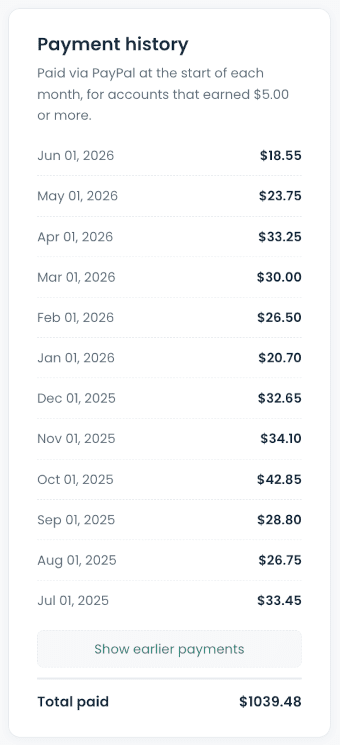
What I can say is that, in my own experience, Serpclix has provided monthly payments to my PayPal account since I started using it in January 2023.
These payments have totalled $1039.48 USD to date as at June 2026.

The biggest earning month I had was May 2023, where I earned $54.15. My lowest earning month was January 2024, at $5.55.

That is the reason I still use it.

Not because it has made me rich.

Not because it is effortless.

But because it has continued to provide small, reliable payments over time.

For me, that makes it worth mentioning.


Why Payment Reliability Matters

One of the biggest issues with online earning sites is not always earning the balance.

Sometimes the bigger issue is getting paid.

A platform can look good on the surface, but if withdrawals are difficult, delayed indefinitely, or surrounded by confusing conditions, it quickly becomes frustrating.

That is why payment reliability is one of the main things I pay attention to.

In my case, Serpclix has continued to pay through PayPal monthly since the beginning, automatically, and with no need for me to make any withdrawal requests whatsoever.

That does not automatically mean every person will have the exact same experience, but it does make me more comfortable sharing my own.

For me, the site has passed the most important test:

It has actually paid. More than once.


My Honest View

My honest view is that Serpclix is worth trying if you are interested in micro-earning and you understand what you are signing up for.

I would not recommend it as a main income source.

I would not recommend it as a shortcut to financial freedom.

I would not recommend it to someone who wants big returns for almost no effort.

But I would recommend it to someone who is curious about small online earning opportunities and wants to try a site that I have personally used for a long time.

That is the key difference.

This is not me saying, “This will change your life.”

It is me saying, “I have used this since early 2023, it has kept paying me through PayPal, and it may be worth a look if you have realistic expectations.”


Getting Started

If you want to try Serpclix, I recommend starting with the setup guide first.

You can read the guide here:

How to Set Up Serpclix: A Step-by-Step Beginner Guide

Then, once you are ready, you can sign up here:

Sign Up to Serpclix using my Referral Link

Some links in this post may be referral links. That means I may receive a small benefit if you sign up through my link, at no extra cost to you.

I only mention Serpclix because I have personally used it since early 2023 and it has continued to provide monthly PayPal payments during that time.


Final Thoughts

There are a lot of questionable earning sites online, and I understand why people are sceptical of them.

I am sceptical too.

That is why I prefer to judge these things by long-term use rather than first impressions.

Serpclix is not perfect, and it is not a path to instant income. But in my own experience, it has been a genuine micro-earning site that has continued to pay monthly through PayPal since early 2023.

That is why I still use it.

That is also why I am comfortable sharing it now.

Just go in with the right expectations:

Small tasks.
Small earnings.
Steady progress.
No hype.

And if you do decide to try it, use the setup guide so the first steps are easier:

How to Set Up Serpclix: A Step-by-Step Beginner Guide

Sign-up link:

Sign Up to Serpclix using my Referral Link
Posted on Leave a comment

How to Set Up Serpclix: A Step-by-Step Beginner Guide

Introduction

Getting started with Serpclix is not overly difficult, but the initial setup can feel a little confusing the first time through the process. The same can be said when updates are made available. That is why I created this Serpclix setup guide.

I have created this guide to minimise any friction that may arise when setting up for the first time, or performing the updates.

I have been using Serpclix since early 2023, and it has consistently provided monthly payments to my PayPal account in USD. Because of that, I am comfortable recommending it as a genuine micro-earnings site – with one important clarification:

This is not a get-rich-quick platform.

It is a micro-earnings site, which means the earnings are small, gradual, and depend on what tasks or earning options are available to you. If you go in with realistic expectations, it can be a useful little side earner.

This guide is designed to help new users get through the setup processes more easily, especially the parts that may not be obvious the first time around.


Before You Start

Before creating your account, it is worth having a few things ready.

You will need:

  • a valid email address
  • access to PayPal
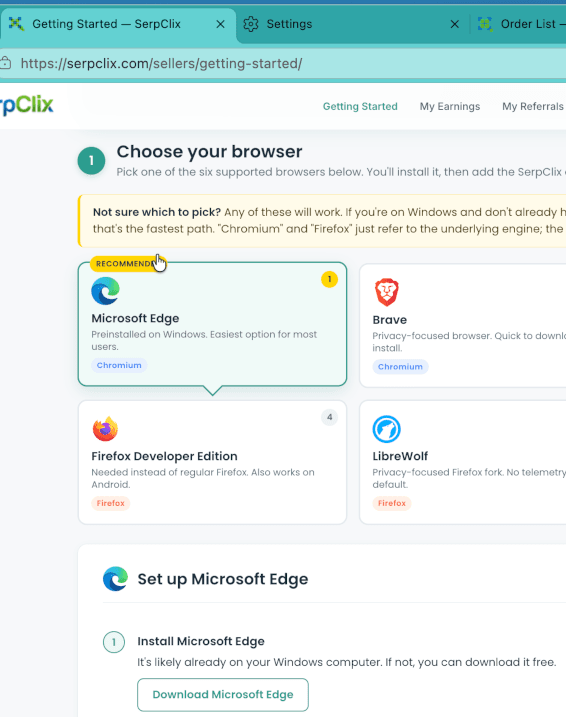
  • a desktop or laptop browser – Microsoft Edge is the recommendation, especially due to the extension that needs to also be installed later. I will cover that too.
  • a little patience during the first setup
  • time to read each step carefully

This particular platform will work only with a desktop/laptop setup. Mobile browsers are not supported.

As this guide uses Edge in the example, the recommendation is that you follow along using that browser.
Once you have installed Edge, open this blog post in it to make the guide easier to follow along with.
You can use this link (right-click->copy link or copy link address) and paste it into the Edge URL address bar.


Step 1: Open the Sign-Up Page

To begin, visit the Serpclix sign-up page here:

You will want to SIGN UP AS A CLICKER

This link will open in a new tab.

This is a referral link. If you sign up through it, I may receive a small benefit at no extra cost to you. I only recommend this site because I have personally used it since early 2023 and it has continued to pay me.

Once the sign-up page opens, click on the ‘SIGN UP AS A CLICKER’ button.


Step 2: Create Your Account

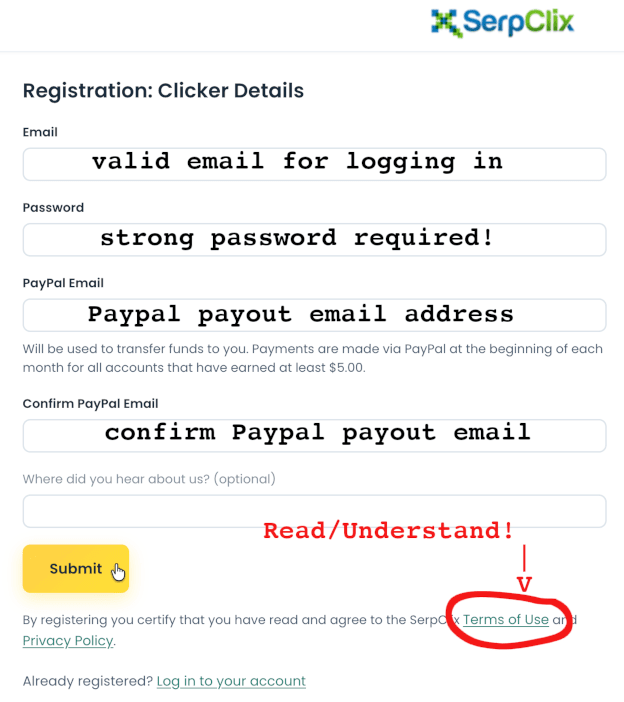
Enter the required details, such as your email address, password, and your Paypal email address. If you do not yet have Paypal, sign up for an account at Paypal.com

Make sure you use an email address you can actually access, because you may need to confirm your account before you can continue.

After entering your details, submit the registration form.

Tip:
Use a strong password and store it somewhere safe. You do not want to lose access to an account that may later hold earnings or payment details. On a similar note, you want to keep it secure to prevent unauthorised access.


Step 3: Confirm Your Email Address

After signing up, check your email inbox for a confirmation message from Serpclix.

You may need to click a confirmation link before your account becomes fully active.

Also check your spam or junk folder if the email does not arrive within a few minutes.

Once confirmed, return to Serpclix and log in.


Step 4: Log In to Your Dashboard

After confirming your email, log in to your account.

You should now arrive at your main dashboard. This is where you will find your earning options, account settings, profile details, payment settings, and progress information – all under their convenient sections.

Do not worry if the dashboard feels a bit busy at first. Most micro-earning platforms have a few different sections, and it may take a little time to understand what each one does.


Step 5: Complete Your Profile

One of the most important early steps is completing your profile, and confirming that everything is correct.

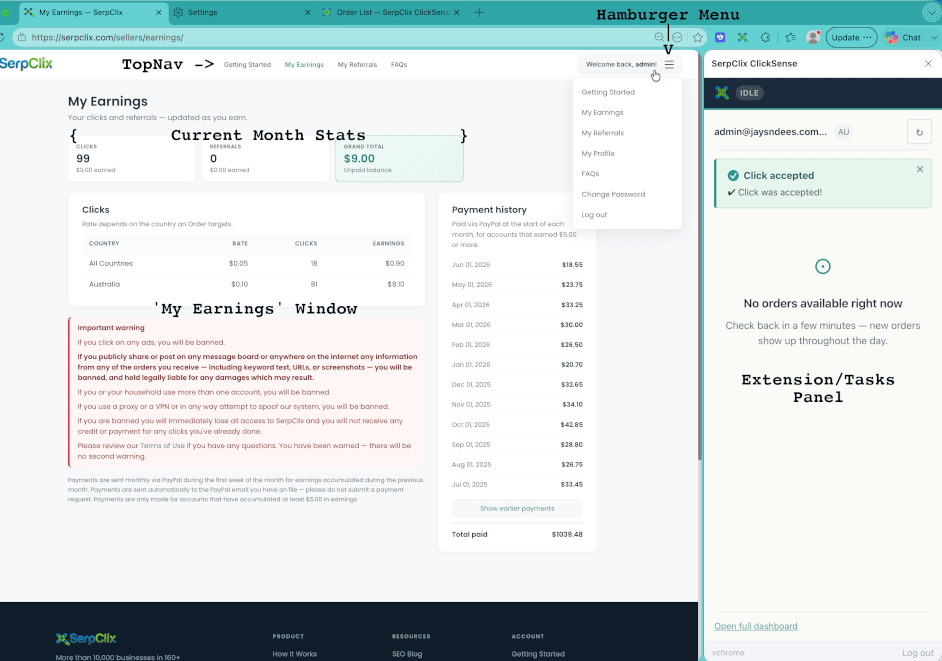
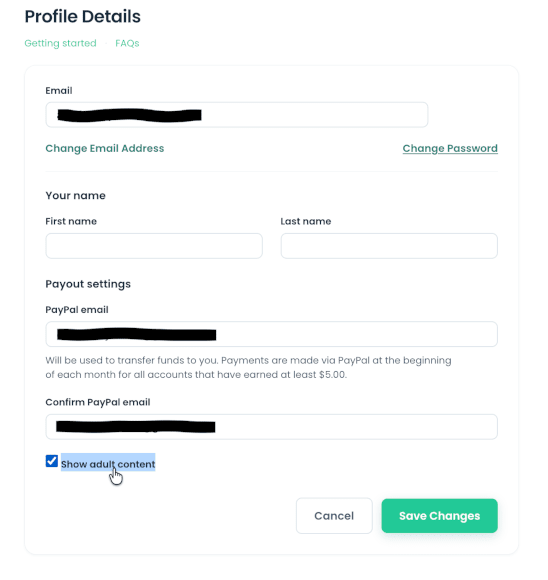
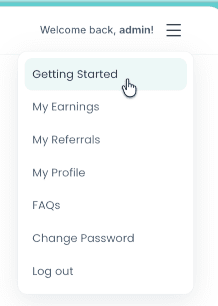
Use the Hamburger menu on the top right of the window, and select My Profile.

Check that everything is correct, and if you wish, also select the ‘Show adult content” checkbox.
Obviously you will need to ensure that you are the age of majority for this one, but to date, there has been very minimal porn. The majority of ‘adult’ searches are for gambling related searches.

Do not try to ‘game’ the system by entering false information. That can lead to poor task matches, rejected earnings, or account issues later.


Step 6: Download and install the Extension Interface

Serpclix uses an extension to allow the user to interact with the earning platform.

This extension needs to be downloaded, unzipped, and added into Edge to work.

At the time of writing, the extension version is v4.0.3.

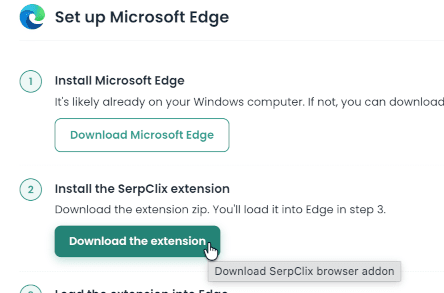
You can access the extension download link by either navigating to the ‘Getting Started’ section.
This can be done either via the Hamburger menu, or the top navbar.

Click on the button ‘Download the extension’.
It will not take long to download. Make sure you save the ZIP file somewhere easily accessible such as your Downloads folder, or similar.

Once it has downloaded, the next step is to extract the files. Ensure they remain in the folder once extraction completes.

Now we can load the extension into Edge.

This is completed as follows:

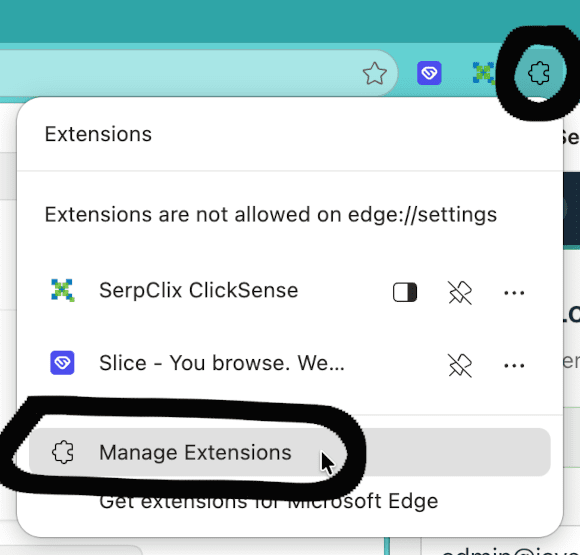
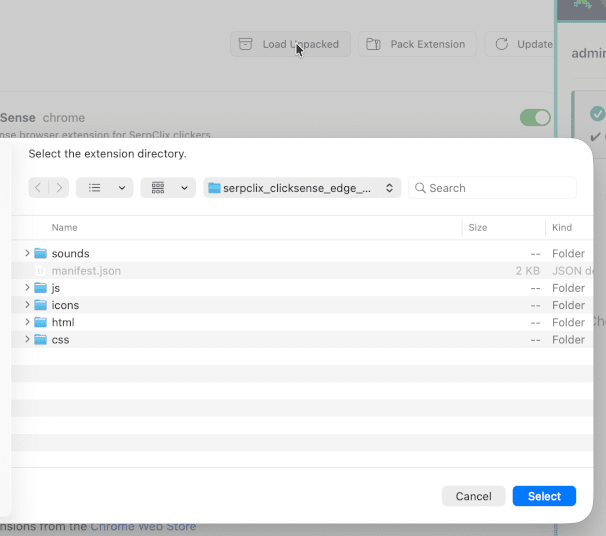
  1. Open the Extensions window. It can be accessed via the jigsaw puzzle icon, located to the right of the address bar. Then select ‘Manage Extensions’.
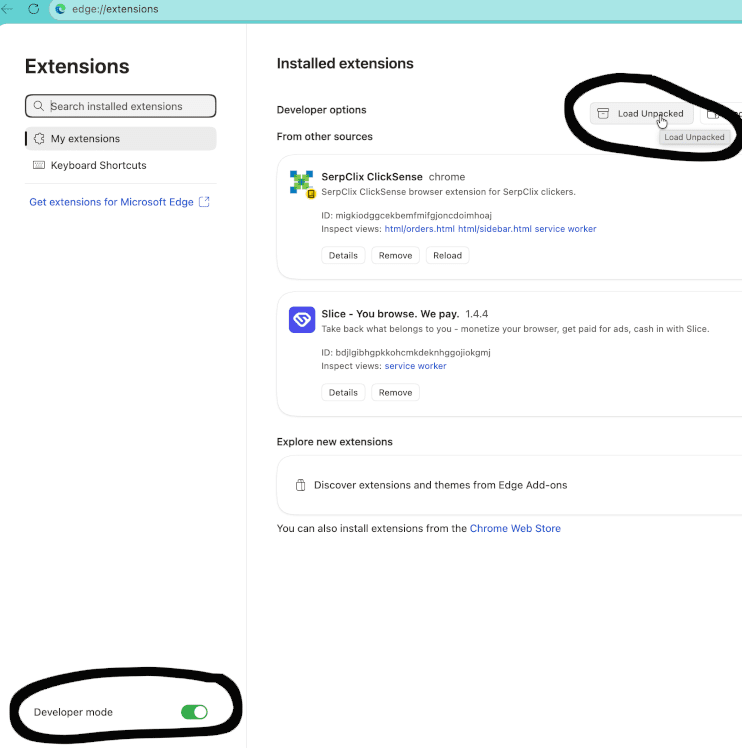
  2. Enable Developer Mode by using the toggle at the bottom left. This step is essential as it will allow adding the Serpclix extension to Edge.
  3. Click the ‘Load Unpacked’ button.
    Navigate to the location where you unpacked the ZIP file, and open the folder that it unpacked into.
    You should see a number of folders, and also a file called ‘manifest.json’.
    Click the ‘Select’ button.
  4. The extension will successfully install. Once complete you can close the Extensions window.
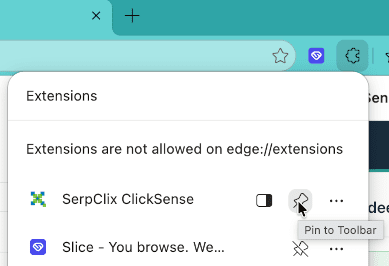
    Although it is installed, it is not conveniently accessible. Fix this by clicking the puzzle piece icon again, and then click on the Pin beside the extension name.
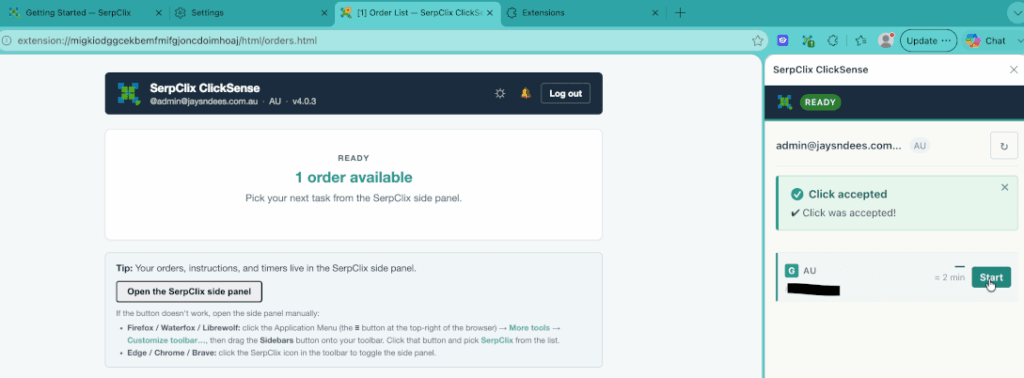
  5. Now you can click on the newly visible icon and sign into the extension using the same credentials you chose when signing up to Serpclix.

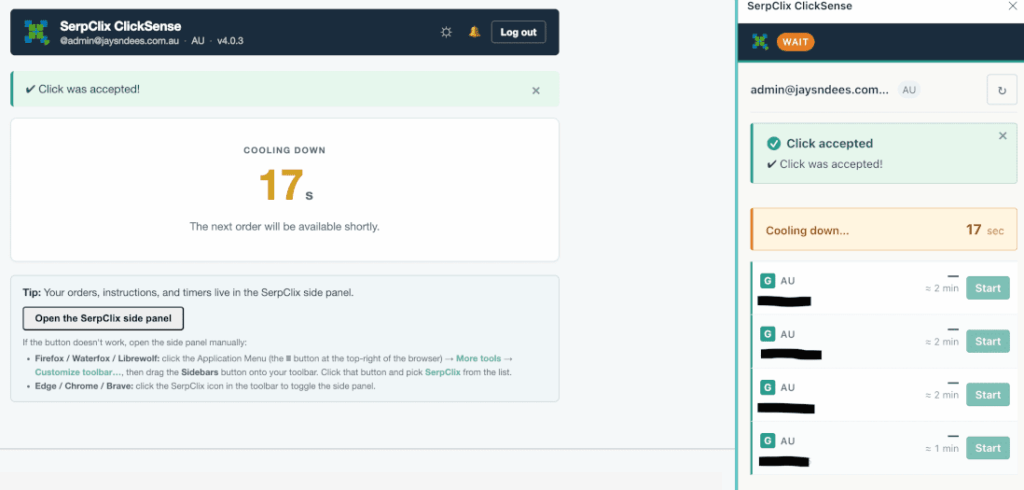
Recently with the Version 4 upgrade, the way the extension looks is different to what is shown in the Getting Started section.
The process is the same, but how it is displayed is different.

First, the extension is now a side window within the main Edge browser. This makes accessing your tasks a little easier.
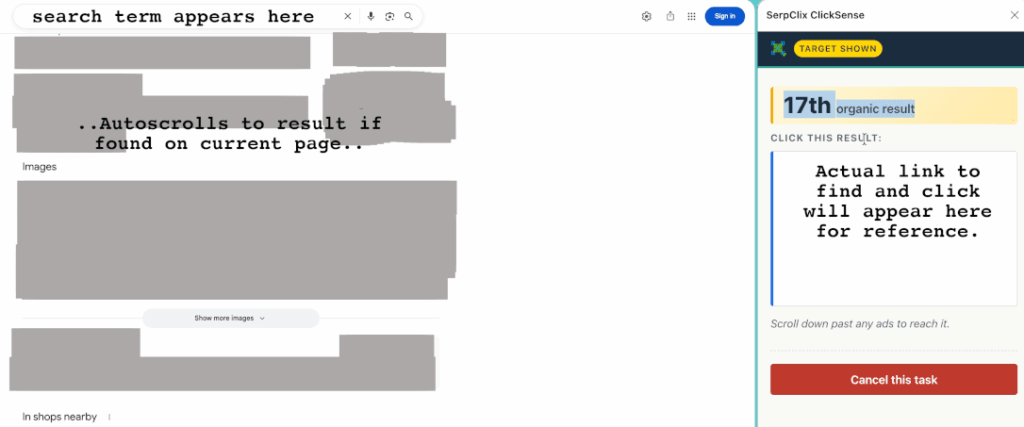
Second, the click task no longer gets highlighted when the match is found. Instead, you are given a visual results representation to look for in the search results.
Third, the extension seems to auto-logout after a period of inactivity. Check it regularly to ensure that you keep up with the tasks – they do not stay around all day, so you can not just ‘log in once a day’ and expect to be able to make anything.

Updating the Extension

From time-to-time, extension updates may become available. These will usually be bug fixes.

Updating the extension is usually done by:

  1. Download the latest extension version and unzip it to a convenient location.
  2. Click the jigsaw puzzle piece ->Manage Extensions
  3. Click on the ‘Remove’ button for the Serpclix extension
  4. Click on the ‘Load Unpacked’ button, and navigate to the new extracted folder location. Click the ‘Select’ button.
  5. Remember to ‘Pin’ it for ease of access.
  6. Login to the new extension interface using your credentials.
  7. Enjoy as before.

Step 7: Your Earnings

Your earnings are automatically paid to your Paypal account within the first week of each month, provided you have reached the minimum threshold. If you haven’t quite made it, do not worry – your total will roll-over towards the next month of earnings.

You do not need to request payouts or anything like that – it is all done automatically.

You can easily access your current earnings by using the Hamburger menu, or the topnav bar, and selecting ‘My Earnings’.

Suggested screenshot:
Screenshot 7: Earning options area or task menu.


Step 8: Understand the Minimum Payout

As previously mentioned, payouts are automatic – as long as you have reached a minimum $5 during the month. Payouts are made in USD.

If you do not reach the minimum for the month, they simply roll-over into the net month.


Step 9: How Do The Tasks Work?

Tasks are very easy to perform.

You are notified when there is new Task/s available.

You simply click on one via the extension, paste the result into the search engine that appears (if not a direct link), and find it on the results pages.
When found, you click it, and then wait for the timer to countdown. You can view the resulting page, or carry on with doing whatever else you were doing.
DO NOT close the browser OR the window that opened – you will not be credited if you do!

Once the timer reached Zero, the window will automatically close, at which point you will be credited for your effort.

There is a 30 second ‘cooldown time’ between allowable clicks. This keeps the search engines happy.

Complete all your tasks – more get added throughout the day so ensure you check regularly!

My highest monthly total was $54.15.


Step 10: Keep Expectations Realistic

This is probably the most important part of the whole guide.

Serpclix is a micro-earnings PTC site. That means it is designed for small amounts of extra money, not a full-time income.

I personally view it as a small side earner. It has been reliable for me, and the monthly PayPal payments are the reason I still use it, but I would never describe it as life-changing money.

I admit, I get a little bit excited at the end of each month. Especially if USD to AUD is on the more favourable side of $1.50+. But I am still happy with the results each month – as long as they stay above 1:1.

The best way to approach it is:

small tasks, small earnings, steady progress.

If you expect it to replace a wage, you will probably be disappointed. If you treat it as a small extra earner, it makes much more sense.


Common Beginner Mistakes to Avoid

Rushing through the setup

It is better to spend a few extra minutes getting your profile and payment details right, and reading through the Terms of Service than to run into problems later.

Using the wrong PayPal email

Double-check your PayPal email before a payment is sent.

Expecting large earnings immediately

This is micro-earning. The amounts are small, but they are consistant.

Ignoring payout rules

Always check the minimum payout, and the accompanying conditions.
Minimum payout is $5, and is paid within the first few days of the new month for previous month earnings.

Trying too many tasks at once

You can only complete a single task at a time.

Giving false profile information

Be honest with your profile details. Incorrect information can cause issues with task matching or account reliability.


Is Serpclix Worth Using?

For me, yes – but with realistic expectations.

I have used Serpclix since early 2023, and it has continued to provide monthly PayPal payments. That consistency is the main reason I am comfortable writing about it.

However, I would not recommend it to someone expecting quick or large earnings.

It is better suited to people who understand micro-earning sites and are happy to build up small amounts over time.


Final Thoughts

The initial setup for Serpclix can be a little tricky, but once the account is created, confirmed, and linked to PayPal, it becomes much easier to understand.

My advice is to take your time, follow the steps carefully, and treat the site as a small side earner rather than a major income source.

You can sign up here:

Sign up to Serpclix and become a clicker too!

And once again, keep expectations realistic. This is not a get-rich-quick scheme. It is simply a micro-earnings site that, in my own experience, has continued to pay reliably since early 2023.

Posted on Leave a comment

What Makes an Online Income Idea Sustainable (And What Doesn’t)

The internet produces new income ideas constantly.

  • Affiliate programs.
  • Digital products.
  • Mining operations.
  • Trading platforms.
  • Content monetisation.
  • Automation tools.

Every week there is a new claim that a particular method is “the future” of online income.

Most of them are not.

Over time, we realised that the real skill isn’t finding opportunities.

It’s recognising which ones are sustainable.

This became particularly clear while documenting some of our own online experiments, including the real cost of GPU crypto mining and several platform-based projects that looked stable until they weren’t.

Sustainability, it turns out, follows patterns.

The Difference Between Income and Sustainable Income

Many online income ideas can generate money temporarily.

Fewer can do so reliably.

The difference often comes down to five factors:

  • platform dependency
  • volatility exposure
  • time intensity
  • cost structure
  • adaptability

An idea that produces income for a short period may still fail if it cannot survive changes in one of those areas.

Sustainability is not about speed.

It’s about resilience.

Platform Dependency Is the Biggest Risk

One of the most common failure points in online income ideas is platform dependency.

If a model relies entirely on:

  • a single website
  • a single algorithm
  • a single traffic source
  • a single monetisation provider

then the system is fragile.

Platforms change policies.
Algorithms evolve.
Verification rules tighten.

We experienced this directly while diagnosing platform trust and crawl access issues across several services.

The lesson was simple:

When the platform controls the rules, sustainability depends on their priorities – not yours.

The Longevity Test

Whenever we evaluate a new online income idea, we ask a simple question:

Will this still make sense in two or three years?

Many ideas fail this test immediately.

Short-term trends often rely on:

  • hype cycles
  • temporary market imbalances
  • early-adopter advantages

Once those conditions disappear, the opportunity disappears with them.

Sustainable online income ideas tend to reward consistency rather than timing.

They don’t rely on catching a wave.

They survive when the wave fades.

Cost Structure Matters More Than Most People Realise

Another common mistake when evaluating online income ideas is underestimating cost.

Costs appear in several forms:

  • financial investment
  • electricity or infrastructure
  • platform fees
  • time commitment
  • maintenance effort

When we examined the real cost of GPU crypto mining in Australia, electricity and cooling became the dominant variables.

On paper the model looked viable.

In practice, operating cost slowly eroded the margin.

Many online income models suffer from similar hidden costs.

If those costs scale with activity, sustainability becomes harder.

Time Intensity Is Often the Silent Killer

Some income models require constant monitoring.

Examples include:

  • active trading
  • arbitrage systems
  • algorithm chasing
  • rapid content production cycles

While these methods may generate income, they often trade money for time at an unsustainable rate.

Over time, fatigue becomes the limiting factor.

Sustainable systems tend to allow:

  • predictable effort
  • repeatable processes
  • manageable maintenance

Time intensity should always be part of the evaluation.

Volatility Exposure

Volatility can affect both digital assets and platform economics.

In some cases, volatility is financial:

  • cryptocurrency price swings
  • fiat currency conversion rates
  • advertising revenue fluctuation
  • affiliate payout changes

In other cases, volatility is structural:

  • platform policy updates
  • traffic source instability
  • sudden algorithm adjustments

Models that depend heavily on volatile variables require constant adaptation.

That doesn’t make them impossible.

It just makes them fragile.

Adaptability Determines Longevity

The most sustainable online income ideas share one common trait:

They can adapt.

If one component changes, the entire model does not collapse.

For example:

A content site may survive traffic changes by diversifying sources.
A product model may adjust pricing or distribution channels.
A service model may expand or narrow its scope.

Rigid systems break.

Flexible systems survive.

This is the same principle we apply across other areas of family life – build simple systems that can evolve over time.

Small Experiments Beat Big Commitments

Another lesson from running online experiments is the importance of controlled testing.

Instead of committing heavily to an idea immediately, we prefer to:

  • test the concept at small scale
  • observe the results
  • measure the cost realistically
  • adjust before expanding

This mirrors the approach we describe in our reflections on running real-world experiments as a family.

Experiments provide information.

Information improves decisions.

Recognising Red Flags

Certain patterns tend to appear repeatedly in unsustainable models.

Common red flags include:

  • promises of guaranteed income
  • extreme time pressure to start immediately
  • opaque fee structures
  • reliance on recruitment rather than value creation
  • unclear cost breakdowns

These signals do not automatically mean an idea is fraudulent.

But they usually indicate elevated risk.

Caution is often justified.

What Sustainable Models Usually Have in Common

When online income ideas do prove durable, they often share several traits:

  • transparent economics
  • manageable cost structure
  • moderate growth expectations
  • ability to adapt to platform changes
  • realistic effort requirements

These qualities do not create overnight success.

They create stability.

And stability compounds.

The Role of Documentation

Writing about experiments forces clarity.

When results are documented honestly, it becomes easier to see:

  • what worked
  • what failed
  • what assumptions were wrong

Without documentation, it is easy to remember only the positive outcomes.

Structured reflection reduces bias.

Why Sustainability Matters More Than Speed

Fast income models can be exciting.

But sustainability determines long-term value.

An idea that produces small, steady returns for years often outperforms one that spikes briefly and disappears.

This principle applies across many areas of life.

Consistency compounds.

Final Thought

Online income ideas will continue to appear.

Some will be legitimate.
Some will be overhyped.
Some will fail quickly.

The goal is not to chase every opportunity.

The goal is to evaluate them carefully.

When sustainability becomes the filter, many ideas fall away quickly.

The ones that remain tend to be slower, quieter, and less dramatic.

But they are also the ones most likely to last.

Posted on Leave a comment

Why Most Online Platforms Eventually Break (And How to Prepare)

Online platforms feel stable.

Until they aren’t.

Policies shift.
Algorithms update.
Verification changes.
Access disappears.

The issue isn’t failure.

It’s dependency.


The Illusion of Stability

When traffic flows, stability feels permanent.

But platforms are businesses.

They optimise for their priorities.

Not yours.


Common Failure Patterns

  • Policy changes
  • Algorithm updates
  • Domain verification issues
  • Crawl limitations
  • Monetisation shifts

We’ve experienced several.


The Ownership Principle

Control what you can:

  • Your domain
  • Your hosting
  • Your email list
  • Your documentation

Everything else is rented space.


Diversification Over Dependence

Avoid:

Single traffic source reliance
Single monetisation channel

Build redundancy.


Documentation as Protection

Clear records simplify recovery.

Structured systems absorb disruption better than improvisation.


Final Reflection

Platforms will evolve.

Systems that rely entirely on them become fragile.

Structured ownership reduces volatility.


Posted on Leave a comment

How We Evaluate Online Income Ideas Before Trying Them

The internet produces new income ideas daily.

Affiliate models.
Crypto staking.
Content monetisation.
Platform partnerships.
Digital tools.

The problem isn’t lack of opportunity.

It’s lack of filtration.

Before committing time or money, we apply a structured evaluation process.

Not to maximise returns.

To minimise regret.


Step 1: Total Cost Assessment

We calculate:

  • Upfront financial cost
  • Time commitment
  • Learning curve
  • Infrastructure dependency
  • Opportunity cost

Many ideas look profitable until time is factored in.

Time is rarely refundable.


Step 2: Platform Dependency Check

If the idea relies on:

  • A single platform
  • A single traffic source
  • A single algorithm
  • A single policy framework

We mark it high-risk.

Platform churn is real.

We’ve experienced it.

Diversification reduces fragility.


Step 3: Longevity Test

We ask:

Will this still exist in 2–3 years?

Short-term spikes rarely build durable systems.

We prefer models that:

  • Reward consistency
  • Survive volatility
  • Do not rely on hype

Step 4: Emotional Risk Check

Does this idea:

  • Create pressure to scale quickly?
  • Encourage unrealistic expectations?
  • Depend on constant monitoring?

Emotional volatility is a cost.

We avoid systems that increase stress disproportionately.


Step 5: Exit Strategy

If we stopped tomorrow:

  • What would remain?
  • What losses would exist?
  • What assets would persist?

If nothing remains beyond effort spent, caution increases.


What We Avoid

We avoid:

  • Guaranteed income claims
  • High-pressure timelines
  • Leverage-heavy models
  • Opaque fee structures

Experience teaches caution.


What We Look For

We favour:

  • Transparent structures
  • Controlled exposure
  • Documented experimentation
  • Small initial testing

Scale follows validation.

Not the reverse.


The Broader Lesson

Evaluating online income ideas is less about opportunity.

More about filtration.

Structure protects focus.


Posted on Leave a comment

How to Convert Cryptocurrency Safely Without Centralised Exchanges

Converting cryptocurrency usually means using a centralised exchange. For many people, that’s fine – but it isn’t the only option, and it isn’t always the best one. This is a reason that many people seek to convert cryptocurrency without centralised exchanges.

For crypto-to-crypto swaps in particular, decentralised exchanges offer an alternative that keeps funds in your own wallet rather than on a third-party platform.

Over time, I’ve found myself increasingly interested in alternatives that reduce custodial risk, minimise account dependencies, and keep control of funds in my own wallet. That curiosity led me to decentralised exchanges and on-chain swaps.

This post explains how to convert cryptocurrency safely without using centralised exchanges, what trade-offs to expect, and when this approach makes sense – and when it doesn’t.

This is not financial advice. It’s a practical, experience-based overview intended to help you understand the landscape and make informed decisions.

Why Some People Avoid Centralised Exchanges for Crypto Conversion

Centralised exchanges offer convenience, liquidity, and familiarity. They also introduce a number of risks that are easy to overlook.

Common concerns include:

  • custodial risk (you don’t control the private keys)
  • account freezes or withdrawals being paused
  • KYC and identity exposure
  • reliance on a single platform remaining solvent and operational

None of these risks mean centralised exchanges are “bad”. They simply mean they are a trade-off, not a default.

For some conversions – particularly crypto-to-crypto swaps – decentralised options can reduce exposure to these issues.

What “Without Centralised Exchanges” Means in Practice

Avoiding centralised exchanges doesn’t mean avoiding infrastructure entirely.

In practice, it usually means:

  • using non-custodial wallets
  • interacting directly with smart contracts
  • swapping assets via decentralised liquidity pools

You still rely on:

  • blockchains
  • smart contracts
  • network fees

The difference is control. Funds never leave your wallet unless you explicitly approve a transaction.

This preference for control over convenience mirrors how I approach other technical and personal systems elsewhere on this site.

What You Need to Convert Cryptocurrency Without Centralised Exchanges

Before attempting any decentralised conversion, there are a few prerequisites.

1. A Non-Custodial Wallet

This is essential. A non-custodial wallet gives you control over your private keys.

Popular examples include:

  • MetaMask
  • Trust Wallet
  • hardware wallets paired with browser extensions

Security basics matter here:

  • store your seed phrase offline
  • never share it
  • double-check wallet addresses

2. Network Awareness

Crypto assets live on specific blockchains. ETH on Ethereum is not the same as ETH bridged elsewhere.

Before converting:

  • confirm the network your asset is on
  • confirm the network the swap will occur on
  • ensure you have enough native token for gas fees

Most failed swaps happen because of network mismatches or insufficient gas.

3. A Decentralised Exchange (DEX)

A DEX allows you to swap assets directly from your wallet using smart contracts.

Examples include:

  • Uniswap (Ethereum and compatible chains)
  • SushiSwap
  • chain-specific DEXs depending on the network

DEXs do not hold your funds. They simply facilitate swaps via liquidity pools.

How a Decentralised Crypto Swap Works Step by Step

At a high level, the process looks like this:

  1. Connect your wallet to the DEX
  2. Select the asset you want to swap from
  3. Select the asset you want to receive
  4. Review the quoted rate and slippage
  5. Approve the token (first-time only)
  6. Confirm the swap transaction

All of this happens on-chain. You can view the transaction on a block explorer once it’s confirmed.

Nothing is instantaneous – and that’s a feature, not a flaw.

Understanding Slippage and Pricing Risk on Decentralised Exchanges

Unlike centralised exchanges with order books, most DEXs use automated market makers.

This means:

  • prices move based on liquidity
  • large trades can shift the rate
  • slippage tolerance matters

Key safety practices:

  • start with small test swaps
  • use conservative slippage settings
  • avoid illiquid token pairs

If a deal looks too good, it usually is – often due to low liquidity or malicious tokens.

Common Safety Mistakes When Using Decentralised Exchanges

Decentralised swaps remove some risks, but introduce others.

1. Interacting With Fake Tokens

Always verify:

  • token contract addresses
  • official project documentation
  • multiple sources

Never rely solely on token names.


2. Approving Unlimited Spending

Many wallets allow you to approve unlimited token allowances.

Safer practice:

  • approve only what you intend to swap
  • periodically review and revoke allowances

This reduces damage if a contract is compromised later.


3. Ignoring Gas Fees

Gas fees can make small swaps uneconomical, especially on congested networks.

Always check:

  • current network fees
  • whether the swap value justifies the cost

Sometimes the safest move is simply waiting.


When It Makes Sense to Convert Crypto Without Centralised Exchanges

Using decentralised exchanges is often well-suited when:

  • converting crypto-to-crypto
  • avoiding custodial exposure
  • experimenting with small amounts
  • prioritising control over convenience

It is less suitable when:

  • converting to fiat
  • needing deep liquidity for large trades
  • requiring customer support

There is no universally “best” method – only appropriate ones for specific situations.

Taxes and Record-Keeping for Decentralised Crypto Swaps

Decentralised does not mean invisible.

On-chain transactions are public, and in many jurisdictions crypto-to-crypto swaps are taxable events.

Good habits include:

  • keeping transaction records
  • exporting wallet histories
  • using tracking tools where appropriate

This is an area where convenience tools can be genuinely helpful.

Final Thoughts

Converting cryptocurrency without centralised exchanges isn’t about ideology or avoiding rules. It’s about understanding your options and choosing the level of control and risk that fits your situation.

Decentralised exchanges offer powerful tools – but they require care, patience, and responsibility. Used thoughtfully, they can reduce certain risks while introducing others that are easier to see and manage.

As with most things in crypto, safety comes less from the platform you choose and more from how well you understand what you’re doing.

If you are interested in donating to the Jays n Dees projects using cryptocurrency, you can find a list of our crypto addresses on our Jays n Dees Crypto Addresses page.
Thankyou in advance.


RELATED ARTICLES:

Posted on Leave a comment

The Real Cost of GPU Crypto Mining in Australia (and why I stopped)

For several years, I ran a GPU-based cryptocurrency miner almost continuously. It wasn’t a casual experiment that flicked on and off – it was something I committed to, tuned carefully, and stubbornly kept running even when conditions were far from ideal. GPU crypto mining in Australia is not as easy as it seems.

I mined a handful of different coins over that time, including Ethereum (ETH), Ethereum Classic (ETC), and Vertcoin (VTC). Like many people who get into home GPU mining, I approached it with a long-term mindset: optimise efficiency, minimise downtime, and let time do the work.

What ultimately pushed me to shut it down wasn’t a single dramatic failure or a sudden change in the market. Instead, it was the slow accumulation of very real, very physical costs – heat, noise, power usage, and lifestyle friction – that are rarely discussed honestly in mining guides.

This post isn’t an argument against GPU mining. It’s a reflection on what running one actually costs in Australia, particularly in Queensland, and why I eventually decided it was no longer worth continuing.

My GPU Crypto Mining Setup (Hardware, Coins, and Efficiency)

This was never an ASIC operation or an industrial-scale setup. My miner was GPU-based, built with a focus on flexibility and efficiency rather than raw hash power.

The system ran a single RX580 GPU and was tuned conservatively:

  • undervolted where possible
  • power limits carefully adjusted
  • stability prioritised over peak performance

The goal was to strike a balance between hashrate, power draw, and longevity. I wasn’t chasing short-term gains or hopping between coins daily. I was comfortable mining steadily, accumulating gradually, and reassessing over time.

At different points, I mined:

  • ETH before the shift away from proof-of-work
  • ETC as a continuation path
  • VTC for its ASIC-resistant philosophy

On paper, the setup made sense. In practice, the challenges weren’t purely technical.

Heat Output and Cooling Issues Running a GPU Miner in Queensland

If you’ve never lived with a running GPU miner, it’s hard to appreciate just how much heat they generate – not in theory, but in daily life.

Queensland summers are already unforgiving. Adding a machine that dumps a constant stream of warm air into your living space changes the equation entirely.

Even when ambient temperatures were manageable, the room housing the miner would climb noticeably. In summer, it became a persistent source of discomfort – from both the heat and the noise. Air conditioning helped, but that introduced a second-order problem: you’re now using more electricity to cool a machine that’s already consuming a significant amount of power.

To keep temperatures within safe limits, I ran pedestal fans continuously to assist airflow. They did their job, but they added:

  • more noise
  • more power usage
  • more moving parts that could fail

At some point, you realise you’re no longer just “running a miner” – you’re actively managing GPU miner heat output as a daily operational concern.

Noise and Constant Fan Operation in Home GPU Mining

Most mining discussions mention noise briefly, if at all. In reality, it’s one of the most wearing aspects over time.

Even with quality fans and reasonable airflow design, a GPU miner is never silent. The constant background hum becomes part of your environment – until one day you realise how tense it makes you feel.

It’s not that the noise is unbearable in isolation. It’s that it never stops.

Daytime, night-time, weekends – there’s no off switch if you’re running continuously. Over months and years, that background noise becomes a form of low-grade stress. You stop noticing it consciously, but your nervous system doesn’t.

This is one of those costs that doesn’t appear in spreadsheets, yet it has a real impact on quality of life.

Electricity Costs of GPU Crypto Mining in Australia

Australia doesn’t enjoy particularly cheap residential electricity, and even an efficiently tuned GPU miner draws a non-trivial amount of power.

Yes, it’s possible to optimise:

  • undervolting GPUs
  • adjusting memory clocks
  • reducing unnecessary overhead

And I did all of that.

Even so, the power bills told a consistent story. Month after month, the miner added a noticeable baseline increase. Not catastrophic – but persistent. Even with a 5kW solar system setup that feeds back into the grid, it was always there.

What made this harder to justify over time wasn’t just the cost itself, but the mental overhead:

  • tracking usage
  • watching rates change
  • recalculating viability
  • wondering whether the next bill would tip the balance

Mining profitability models often assume static conditions. Real life doesn’t.

When GPU Mining Stops Being Worth It Long Term

There wasn’t a single moment where I decided to shut everything down. Instead, it was a gradual shift in perspective.

The miner still worked.
The coins were still accumulating.
Nothing was “broken”.

But the friction kept increasing.

Heat management.
Noise fatigue.
Power costs.
Ongoing attention.

Eventually, I had to accept a simple truth:

Just because a project is technically viable doesn’t mean it’s personally sustainable.

That realisation made the decision clearer. Shutting the miner down wasn’t failure – it was an acknowledgement that the constraints had changed.

Switching from GPU Mining to Cloud Mining (My Experience So Far)

In December 2025, I decided to explore an alternative approach and transitioned into a cloud mining project called GoMining.

This wasn’t a leap of faith or a full endorsement. It was a deliberate experiment.

The appeal was straightforward:

  • no heat output
  • no noise
  • no local power consumption
  • no hardware maintenance

Of course, this comes with a different set of risks – trust, transparency, and counterparty dependence being the most obvious.

At the time of writing, I’m still waiting for my first payout, which will be the point at which I can begin forming a more informed opinion. Until then, I’m treating it as an observation phase rather than a recommendation.

That distinction matters.

I’ll cover my experience converting mined crypto and learning the new style of mining in future posts.

This is not financial advice, and I’m documenting this purely as a personal experiment.

What I’d Do Differently If I Started Again

Looking back, there are a few lessons I’d carry forward if I were starting from scratch:

  • Account for lifestyle costs early
    – Heat, noise, and attention are real inputs, not side notes.
  • Define an exit condition upfront
    – Knowing when you’ll stop prevents emotional attachment.
  • Treat mining as an experiment, not an identity
    – Detachment makes rational decisions easier.
  • Reassess assumptions regularly
    – What made sense a year ago may not today.

These lessons apply well beyond crypto.

Who This Experience Will (and Won’t) Be Useful For

If you’re considering GPU crypto mining in Australia, particularly in warmer climates, this experience is worth factoring into your decision.

GPU mining can still make sense if:

  • you have access to cheap power
  • you can isolate heat and noise effectively
  • you enjoy the hands-on aspect

It’s probably not a good fit if:

  • you’re sensitive to environmental discomfort
  • you’re expecting “set and forget” income
  • you underestimate the ongoing friction

For me, shutting down my GPU miner wasn’t about abandoning crypto – it was about recognising when a project had run its course.

And sometimes, that’s the most valuable outcome of all.

This post reflects my own experience and circumstances, which may differ significantly from others.