
Posted on Leave a comment

Building Low-Friction Kitchen Systems for a Large Family

Feeding a large family every day is less about cooking skill and more about structure.

In a household of six, the kitchen becomes one of the most active systems in the house. Meals happen multiple times a day. Groceries move quickly. Small inefficiencies multiply fast.

Without structure, the kitchen becomes reactive:

What’s for dinner tonight?
Do we have the ingredients?
Who ate the leftovers?
Why are we out of milk again?

None of these problems are dramatic on their own.

But repeated every day, they create friction.

That’s why we began developing simple kitchen systems for a large family – not to optimise food, but to reduce daily decision pressure.

Why Kitchens Become Stress Points

Most household kitchens operate on improvisation.

Someone opens the fridge and decides what to cook. Grocery shopping happens when something runs out. Meals change depending on mood or time.

Improvisation works occasionally.

But when feeding multiple people every day, improvisation creates unpredictability.

Unpredictability leads to:

  • last-minute grocery runs
  • repeated decision fatigue
  • inconsistent meal timing
  • food waste

A kitchen system doesn’t eliminate flexibility.

It simply adds structure underneath it.

The Goal: Reduce Repeated Decisions

The first principle behind kitchen systems for a large family is simple:

Reduce repeated decisions.

Many food decisions happen every day:

  • lunch packing
  • dinner planning
  • snack availability
  • grocery replenishment

Instead of solving each decision individually, we built repeatable patterns.

These patterns absorb the daily friction.

Anchor Meals Make Everything Easier

One of the most useful kitchen systems is identifying anchor meals.

Anchor meals are:

  • repeatable
  • scalable
  • easy to prepare
  • widely accepted by the household

They are not special meals.

They are dependable ones.

For us, meals like The Bread Thing and our Mediterranean Pasta Salad function as anchors because they:

  • feed multiple people easily
  • adapt to ingredient variations
  • produce leftovers when needed

Anchor meals reduce the pressure of constantly inventing new dinners.

Structure Without a Rigid Meal Plan

We don’t follow a strict weekly meal plan.

Instead, we use a loose structure.

Typical rhythm:

  • 2–3 anchor meals per week
  • 1 flexible leftover night
  • 1 quick meal option
  • 1 experimental or seasonal meal

This structure creates predictability without locking us into a rigid schedule.

Flexibility still exists.

But the framework absorbs most decision-making.

Ingredient Systems Reduce Shopping Stress

Another important kitchen system is ingredient standardisation.

Certain items are always stocked:

  • pasta
  • rice
  • frozen vegetables
  • cheese
  • bread
  • eggs
  • basic sauces

These ingredients support multiple meals.

If a dinner plan fails unexpectedly, fallback meals are still possible.

This reduces panic buying and mid-week grocery runs.

It also stabilises grocery spending, something we discuss more deeply in our breakdown of the cost to feed a family of six in Australia.

Prep Rhythms Matter More Than Recipes

Many kitchen frustrations don’t come from recipes.

They come from timing.

For example:

  • vegetables being prepared while the pan is already heating
  • searching for ingredients mid-cooking
  • discovering missing items too late

We found that small preparation rhythms remove these problems.

Examples include:

  • chopping vegetables early in the cooking process
  • measuring ingredients before heat starts
  • organising preparation zones on the bench

These habits are simple.

But repeated daily, they create smoother cooking.

Batch Thinking Reduces Workload

Another useful principle is batch thinking.

When certain ingredients are already being prepared, making extra saves effort later.

Examples:

  • cooking extra pasta for next-day lunches
  • preparing additional rice for another meal
  • roasting larger trays of vegetables

Batch thinking doesn’t require full meal prepping.

It simply recognises that cooking once can support multiple meals.

Fridge Visibility Reduces Waste

One surprising lesson from building kitchen systems was the importance of visibility.

When ingredients are hidden behind others, they tend to be forgotten.

Forgotten food becomes waste.

We now try to keep the fridge organised so that:

  • leftovers are visible
  • produce is easy to see
  • older items move forward

This small habit dramatically reduced wasted ingredients.

Waste reduction is one of the easiest ways to lower food costs without changing what you eat.

The Role of Seasonal Awareness

Seasonal timing also influences kitchen systems.

Certain foods are naturally cheaper and more abundant at specific times of year.

Adjusting meals to seasonal availability can reduce grocery cost and improve quality.

This idea connects closely to our broader reflections on seasonal food planning in Australia and how climate timing influences food cost.

When the kitchen system aligns with seasonal supply, grocery stress decreases.

Kitchen Systems Are Family Systems

Kitchen systems are not isolated.

They interact with other systems in the household.

For example:

  • meal predictability supports weekly planning
  • grocery consistency supports financial tracking
  • leftovers support lunch systems

When systems reinforce each other, daily friction decreases.

This is the same principle behind building simple systems for family life more broadly.

The kitchen simply happens to be one of the busiest areas where those systems operate.

The System Doesn’t Need to Be Perfect

One important lesson we’ve learned is that kitchen systems don’t need to be perfectly organised.

They simply need to be reliable enough.

Even imperfect structure reduces stress compared to constant improvisation.

If a system works most of the time, it is valuable.

Small improvements accumulate.

The Long-Term Effect

After building kitchen systems gradually, several changes became noticeable:

  • fewer last-minute grocery trips
  • less food waste
  • smoother dinner preparation
  • less debate about meals
  • more predictable grocery spending

None of these changes happened overnight.

They emerged slowly as small structures were layered over time.

Final Thought

Feeding a large family will always require effort.

But effort doesn’t have to mean chaos.

Kitchen systems don’t remove cooking.

They remove friction around cooking.

When meals follow simple structures, the kitchen becomes calmer.

And when the kitchen is calmer, the entire household benefits.
Posted on Leave a comment

DIY Maintenance vs Paying a Professional: How We Decide

Maintenance decisions appear simple.

Fix it yourself.
Or pay someone.

In reality, the decision contains multiple variables:

  • Cost
  • Skill
  • Risk
  • Time
  • Consequence of failure

We use a framework to decide.


The Skill Boundary Test

Can we perform this safely?

If safety risk is high, professional wins.

No ego involved.


The Tool Investment Check

Do we already own the required tools?

Buying specialised tools for one task often negates savings.


The Cost Comparison

We compare:

Professional quote
Parts cost
Tool cost
Time investment

Time is factored realistically.


The Risk Assessment

If failure leads to:

  • Property damage
  • Vehicle damage
  • Safety risk

Professional intervention is justified.


The Learning Value Factor

Some tasks are worth doing for skill development.

Others are not worth the risk.


The Balance

DIY builds competence.

Professionals build safety margins.

Balance prevents overconfidence.


Posted on Leave a comment

What It Actually Costs to Feed a Family of Six in Australia

Feeding a family of six in Australia isn’t theoretical.

It’s weekly.

And it’s measurable.

We have:

  • two adults
  • four children
  • mixed ages
  • growing appetites

Over time, we’ve learned that the real cost isn’t just groceries.

It’s structure.


Our Typical Weekly Grocery Range

Depending on the week, we typically spend:

$350–$500 AUD per week

This varies based on:

  • fresh produce prices
  • meat costs
  • school holidays
  • special occasions
  • bulk restocking

Some weeks are lighter.
Some weeks are heavier.

But that range holds consistently.


What Influences the Cost Most

1. Protein

Chicken, beef, mince, bacon – protein is the biggest cost driver.

We reduce volatility by:

  • buying whole chickens
  • using leftovers intentionally
  • incorporating system meals

2. Dairy

Milk, cheese, yoghurt.

These disappear quickly in a household with children.

Bulk purchasing helps.


3. Fresh Produce

Vegetables and fruit fluctuate seasonally.

We:

  • buy seasonal
  • avoid waste-heavy items
  • build meals around what’s affordable

4. Pantry Staples

Pasta, rice, flour, tinned goods.

These are purchased in bulk where practical.

They stabilise meal systems.


What We Don’t Do

We don’t:

  • chase extreme couponing
  • follow restrictive food ideologies
  • eliminate entire food groups
  • obsess over brand loyalty

We aim for:

balanced, practical, sustainable.


The Hidden Cost: Disorganisation

The most expensive grocery bill is the one followed by takeaway.

Structure prevents:

  • mid-week panic ordering
  • forgotten ingredients
  • duplicate purchases
  • expired food waste

Our weekly reset reduces this significantly.


How Systems Reduce Food Cost

When meals are structured:

  • leftovers are reused
  • ingredients overlap intentionally
  • impulse supermarket trips reduce
  • bulk buying makes sense

System meals like The Bread Thing or pasta salad function as anchors.

Anchors stabilise cost.


Cost Per Person (Rough Estimate)

At $400 per week average:

  • $400 ÷ 6 = ~$66 per person per week

This fluctuates but gives perspective.

Not extreme.
Not minimal.
Realistic.


What This Post Is Not

It’s not:

  • a budgeting guide
  • financial advice
  • a complaint about prices
  • a frugality challenge

It’s simply documentation of what feeding six people looks like in Australia.


Final Thought

Food cost is rarely about finding the cheapest option.

It’s about reducing waste and friction.

In our experience, systems matter more than supermarket choice.

And when systems hold, cost stabilises.


Posted on Leave a comment

Mediterranean Pasta Salad: A Low-Heat Family Side Dish That Scales Easily

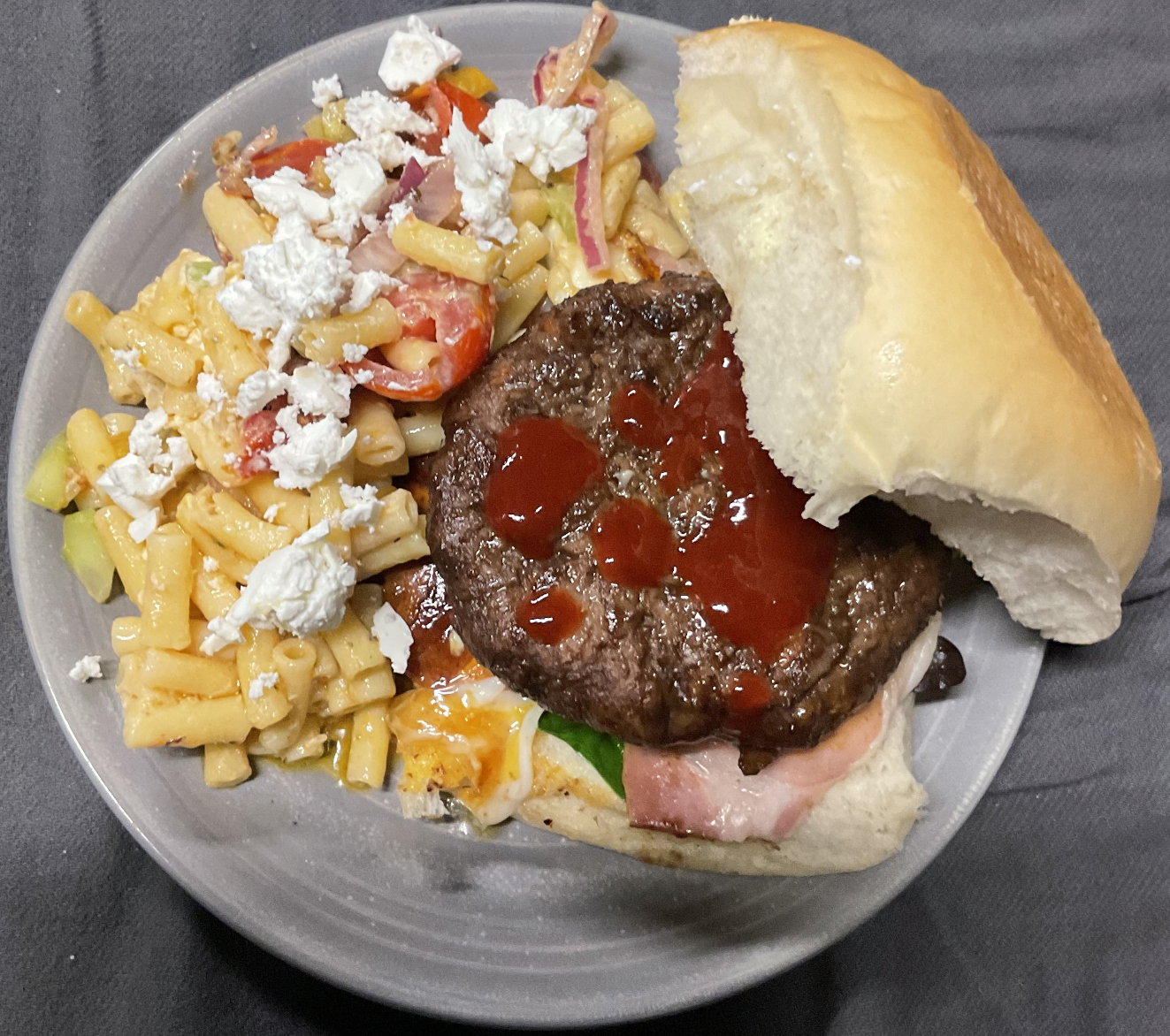
jaysndees Pasta salad dish with burger.

When the temperature climbs, the idea of standing over a hotplate or BBQ loses its appeal quickly.

In those stretches of warm days and warm nights, we lean on meals that require minimal heat but still feel substantial.

This Mediterranean pasta salad became one of those fallback options.

It started as a refreshing side dish for BBQs and family lunches. Over time, it proved something more useful:

It scales easily.
It keeps for a couple of days.
And it survives repetition.

That’s usually the sign of a keeper.


What This Salad Actually Is

At its core, this is a simple combination of:

  • Pasta (fusilli, penne, farfalle, or macaroni)
  • Fresh vegetables
  • Feta
  • A tangy olive oil dressing
  • Optional additions (olives, roasted capsicum, chilli)

It’s colourful without being complicated.

It works as:

  • a BBQ side
  • a family lunch addition
  • a light dinner companion
  • something to bring to a picnic

And it doesn’t demand constant attention once made.


Why It Works in a Family Setting

Side dishes are often overlooked in family meals.

They’re either:

  • too bland,
  • too heavy,
  • or too short-lived in the fridge.

This one balances a few important things:

  • Soft (pasta, feta)
  • Crunch (cucumber, onion)
  • Tang (vinegar, lemon)
  • Freshness (basil)
  • Colour (tomato, capsicum)

That blend makes it interesting without being overwhelming.

It’s also fairly easy to prepare in one session and serve across multiple meals.

That’s what makes it practical.


The Structure Behind It

This isn’t a complicated build.

1. Cook and Cool the Pasta

Boil until al dente.
Rinse under cold water.
Let it cool properly before mixing.

Cooling is important – it prevents the dressing from being absorbed unevenly.


2. Prepare the Vegetables

The standard build includes:

  • Cherry tomatoes (halved)
  • Continental cucumber (diced)
  • Red onion (thinly sliced)
  • Semi sun-dried tomatoes
  • Danish feta
  • Fresh basil

Optional:

  • Kalamata olives (we leave these out initially – most of the household isn’t a fan)
  • Dry-fried red capsicum
  • Fresh sliced chilli

Everything is chopped and ready before assembly.


3. The Dressing

A simple mixture of:

  • Extra-virgin olive oil
  • Red wine vinegar
  • Lemon juice
  • Dijon mustard
  • Garlic
  • Oregano
  • Salt and pepper

Whisked until combined.

No complexity required.


4. Combine and Chill

Mix pasta, vegetables, feta, and basil in a large bowl.

Add dressing and toss until evenly coated.

Then let it sit in the fridge for at least 30 minutes.

This resting period matters – the flavours settle and blend properly.


Why It Keeps Well

Unlike leafy salads that wilt quickly, this one holds its structure.

The pasta absorbs flavour gradually.
The vegetables stay crisp.
The feta softens slightly without disappearing.

It comfortably lasts a couple of days refrigerated, which makes it useful for:

  • leftovers
  • next-day lunches
  • adding to another meal without extra cooking

Variations That Fit the System

Because the structure is stable, small variations don’t break it.

  • Add olives individually when serving (for those who want them).
  • Add fresh chilli for heat.
  • Dry fry capsicum for depth.
  • Use thinly sliced “Onyaks” (our unformed garlic bulbs) for a sharper punch of flavour.

The base doesn’t change.

Only the accents do.


Where It Fits in Our Rotation

This isn’t an everyday dish in our house.

It’s more of a:

  • warm-weather fallback
  • BBQ companion
  • weekend lunch side
  • something to prepare when you want food ready without constant reheating

That said, it could easily shift into a weekly or fortnightly rhythm.

It has the right balance for that.


The System Principle

Meals don’t have to be complex to be useful.

This pasta salad works because it:

  • requires minimal heat
  • scales easily
  • stores well
  • tolerates personal preference adjustments

That combination makes it more than just “a good salad.”

It makes it a low-friction addition to the family food system.

And in a busy household, low-friction matters.


Posted on Leave a comment

The Bread Thing: A Repeatable Family Meal System That Just Works

We like food.

Probably more than we should.

When you’re feeding six people – four of whom are still growing – dinner can’t just be “interesting”. It has to be filling. Repeatable. And preferably not argued over.

The Bread Thing wasn’t planned.

It came out of a few cold, wet nights, a BBQ, and a vague memory of my dad talking about stuffing an entire loaf of bread with chips and gravy when he was younger. That idea stuck somewhere in the back of my head.

Ours evolved a bit further than chips and gravy.

The kids named it after the first time we made it.

The name stuck.

And somehow, it became one of our most reliable dinner systems.


What It Actually Is

At face value, The Bread Thing is simple:

  • One full, unsliced 800g loaf of white bread
  • Hollowed out carefully
  • Layered with chicken, bacon, cheese, gravy, mac and cheese, and veg
  • Garlic buttered
  • Put back on the BBQ
  • Sliced and served

That’s it.

It sounds chaotic written out.

In practice, it’s surprisingly structured.


Why It Works (and Keeps Working)

A meal in our house has to meet a few requirements:

  • It has to fill everyone.
  • It has to survive leftovers.
  • It has to tolerate substitutions.
  • The kids actually have to eat it.

The Bread Thing ticks all four.

It feeds:

  • two adults
  • four kids (currently 14 down to 4)
  • and still gives us enough for a decent lunch the next day.

That alone earns it a place in rotation.


The Structure (This Is the Important Part)

It only works because the structure doesn’t change.

The Shell

The loaf is hollowed carefully:

  • about 1.5cm on the walls
  • about 1cm on the base

It gets a quick pre-toast on the BBQ (we use the outer two burners on high). That firms it up so it doesn’t collapse later.

Structure first. Fill second.


The Core Layers

The usual build looks like this:

  • Mac & cheese mixed with frozen veg on the bottom
  • Shredded BBQ chicken (skin removed first)
  • Bacon pieces
  • Cheese
  • Gravy
  • Repeat layering
  • Finish with more chicken, cheese, bacon
  • Chicken skin on top
  • Lid back on

Everything is pressed gently but not compacted into a brick.

It’s layered deliberately – but it’s not delicate.


The Comfort Factor

The mac & cheese anchors it.
The bacon adds texture and salt.
The gravy binds everything.
The cheese melts it all together.

Vegetables are built in rather than served separately – which avoids the usual side-dish negotiation.

One build. One slice. Everyone fed.


Why the Kids Accept It

Predictability matters more than novelty.

It looks roughly the same every time.
It slices the same way every time.
It feels substantial every time.

One child doesn’t like gravy.

We simply build his portion deconstructed – same ingredients, different layout.

System stays intact.


Why It Scales

Need more? Use two loaves.

Need to swap ingredients? The structure absorbs it.

Chicken can become mince.
Bacon can become salami.
Add jalapeños if you’re brave.
Add more veg if you’re feeling responsible.

The framework doesn’t change.

That’s why it works.


What It Replaces

Without something like this, dinner becomes:

  • “What are we making?”
  • “Who’s eating what?”
  • “We’re out of that.”
  • “Can I just have cereal?”

The Bread Thing removes that whole conversation.

It’s not healthy perfection.
It’s not gourmet.

It’s practical.

And practical scales better than impressive.


The System Principle

This meal survived because it tolerates repetition.

That’s the test.

If something works once, it’s a recipe.
If it works ten times, it’s a system.

The Bread Thing passed that test.


Quick Food Safety Note

Store properly, reheat properly, use common sense.